

Bachelor Degree Course in
Geological Hazards and Environmental Sustainability
Subjects
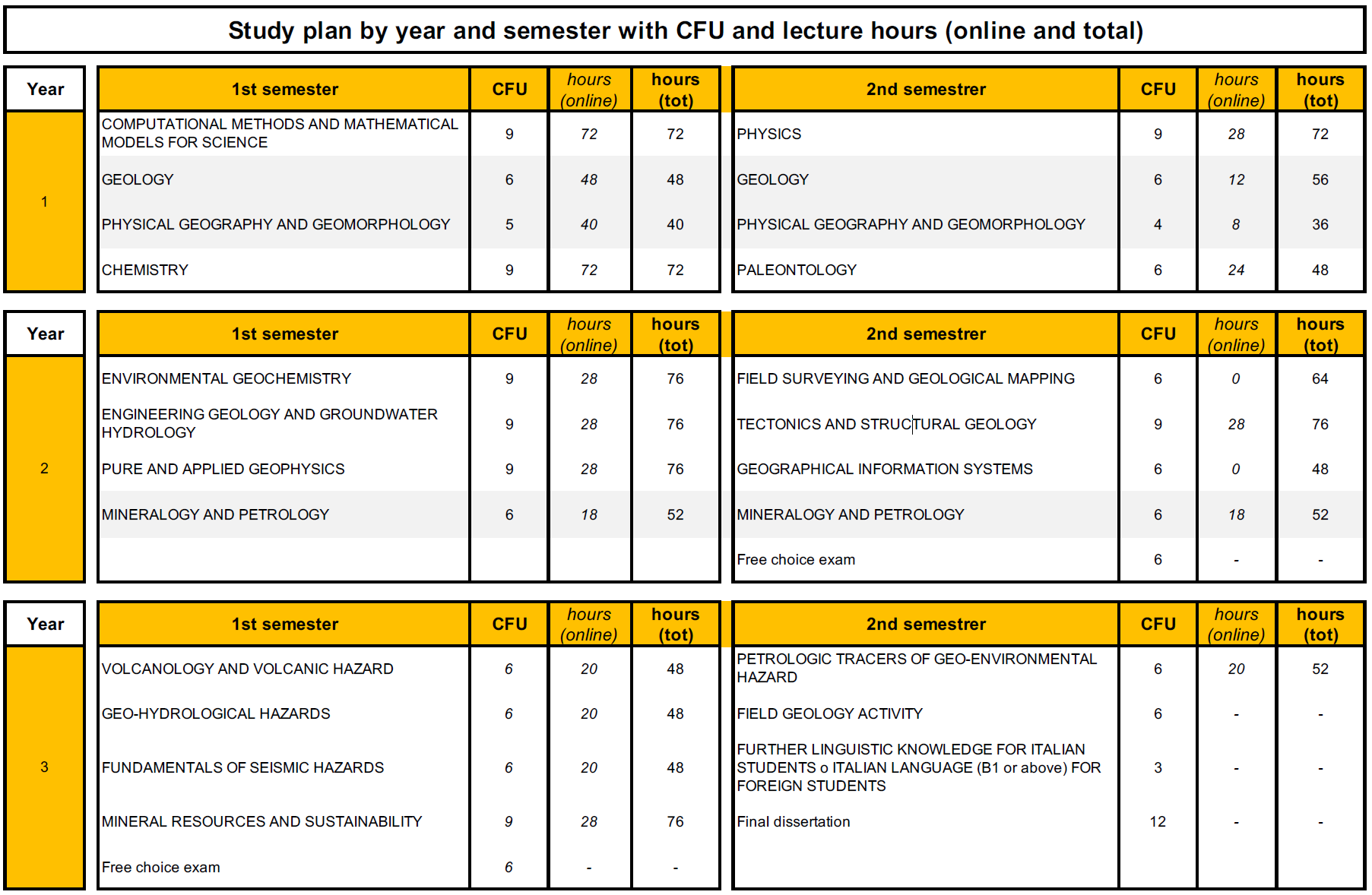
Subject list:
Computational Methods and Mathematical Models for Science. Introduces mathematical models, probability, and computational methods necessary for solving complex geological and environmental problems
Geology. Introduces Earth system dynamics, lithogenic processes, rock recognition, and fundamental stratigraphic and geological time concepts
Physical Geography and Geomorphology. Covers atmospheric dynamics, climate, and relief modelling, examining lithology and structural morphology as factors in the evolution of landscapes
Chemistry. Covers fundamental chemistry topics essential for the rigorous description and scientific interpretation of various geological processes
Physics. Introduces classical and modern physics, including mechanics, thermodynamics, and electromagnetism, with specific applications relevant to the basic training of geologists
Paleontology. Examines the fossil record, formation and application to understand biostratigraphy, paleoecology, and the history of life through geological time
Environmental Geochemistry. Explores mineralogy and petrography to understand mineral associations, magma evolution, volcanic processes, and the compositional variability of environmental waters
Engineering Geology and Groundwater Hydrology. Provides advanced knowledge in hydrology and hydrogeology, focusing on technical geology applications, slope dynamics, and associated environmental hazard risks
Pure and Applied Geophysics. Introduces Earth dynamics, including seismology, magnetism, and gravimetry, using geophysical techniques to study the planet's structure and surface phenomena
Mineralogy and Petrology. Provides a comprehensive understanding of mineralogy, petrography, and petrology for identifying rocks and minerals and understanding their formation processes
Field Survey and Geological Mapping. Principles of mapping, rock body representation, and tectonic structures, focusing on creating geological maps
Tectonics and Structural Geology. Provides advanced training in Earth System evolution and plate tectonics, teaching students to apply theoretical and practical tools for geological analysis
Geographical Information Systems. Teaches GIS knowledge and its practical applications for the forecasting, prevention, and detailed characterisation of geological and environmental risks
Volcanology and Volcanic Hazard. Educates students on physical processes of volcanism, magma ascent parameters, eruption dynamics, and defining hazards associated with volcanic areas
Geo-Hydrological Hazards. Studies slope dynamics, erosion, transport, and sedimentation processes to interpret rapid geological dynamics and hazards for sustainable land management
Fundamentals of Seismic Hazard. Develops theoretical and technical skills for analysing seismic risk, evaluating ground effects, and understanding the statistical properties of earthquakes
Mineral Resources and Sustainability. Focuses on raw materials, mining techniques, circular economy, and waste extraction, while assessing environmental impacts of mineral resource exploitation
Petrologic Tracers of Geo-Environmental Hazard. Applies petrologic tracers to environmental matrices to evaluate volcanological hazards and the impact of geological and anthropic processes on risks
Field Geology Activity. Involves an autonomous group survey in the Apennines, resulting in a detailed geological map, cross-sections, and an interpretative field report
Syllabus of all courses can be downdloaded here (coursecatalogue)
under contruction
TESt page
Last
update
16.09.2026